
Setting up in Bulgaria and operating in Italy: three separate questions
A company incorporated in Bulgaria may have customers, shareholders or business relationships in Italy. Those connections alone do not determine where the company is tax resident. At least three issues must be distinguished: the company’s tax residence under Italian law; whether a non-resident company has a permanent establishment in Italy; and whether CFC rules may apply where an Italian-resident person controls a foreign company.
In common usage, “esterovestizione” describes a situation in which a company is formally located abroad but its actual tax residence is alleged to be in Italy. The term does not replace the statutory tests: the analysis must address the relevant tax period and the organisation actually put in place.
The tax residence tests under Article 73 TUIR
The new wording applies from 1 January 2024. For the relevant tax periods, Article 73(3) of the Italian Income Tax Code (TUIR) treats companies and entities as resident in Italy if, for most of the tax period, at least one of the alternative connecting factors is located in Italy: the registered office, the place of effective management, or the place where ordinary management is principally carried out.
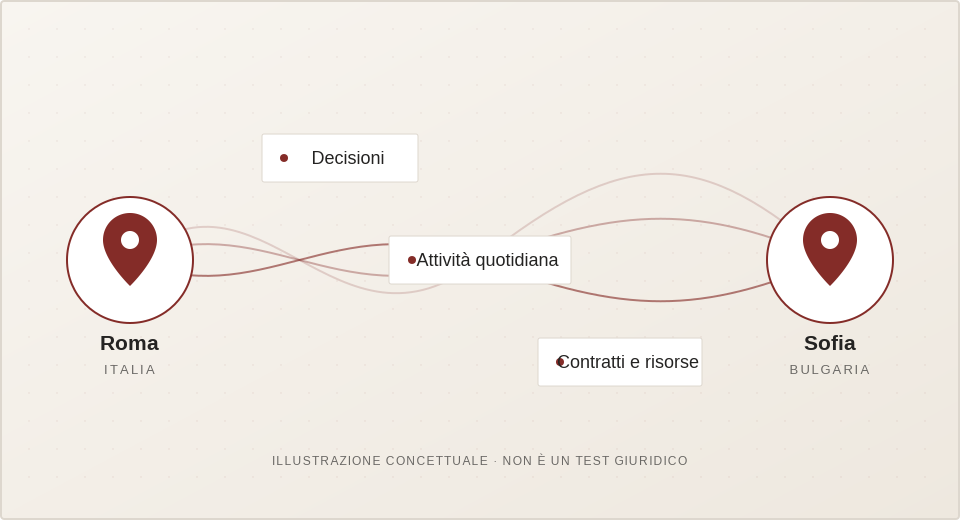
Effective management concerns the continuous and coordinated taking of strategic decisions relating to the company as a whole. Ordinary management concerns the continuous and coordinated performance of current management activities relating to the company as a whole. These are distinct concepts and must be applied to the facts: the location of a meeting, a single contract, or a shareholder’s or director’s residence does not, by itself, determine the answer.
What to establish in practice
The review should establish who takes strategic decisions and where, who handles day-to-day management, what powers the directors have, and how they exercise them. It should also examine staff, premises, resources and functions in both countries; contract negotiations and signatures; customer and supplier relationships; financial resources; minutes, delegations, correspondence and decision-making flows. No standard document, registered address or formal set of minutes can replace an examination of the company’s actual activity.
The evidence should be considered as a whole and in relation to the period concerned. A company organised in Bulgaria may have links with Italy without thereby automatically becoming Italian tax resident; conversely, Bulgarian registration alone is not decisive if the relevant functions are actually carried out elsewhere. The outcome depends on the combined facts and the applicable rules.
The Italy–Bulgaria tax treaty and dual residence
In defining a treaty resident, the Italy–Bulgaria Convention includes legal persons whose registered office is in Bulgaria or which are registered there. Where, under the laws of both States, a person other than an individual is resident in both, Article 1(4) of the Convention deems it resident for treaty purposes in the State where its place of effective management is situated.
The treaty rule must not be confused with the domestic test under Article 73 TUIR, and its outcome cannot be assumed without establishing the facts. The Convention, domestic law, relevant tax period and company’s actual organisation must be considered together.
Permanent establishment: a foreign company operating in Italy
A company that is not Italian tax resident may carry on business in Italy through a permanent establishment if the requirements under Article 162 TUIR and the Convention are met. In brief, this may involve a fixed place of business through which the enterprise carries on all or part of its business; an agent acting on the enterprise’s behalf may also be relevant under the applicable statutory and treaty conditions.
The existence of a permanent establishment does not, by itself, make the entire company resident in Italy. These are separate questions, each with its own consequences and analysis. Any exceptions for preparatory or auxiliary activities must also be applied to the facts and the relevant treaty text.
CFC rules: a separate regime from tax residence
Where the statutory conditions are met, Article 167 TUIR may require income of a foreign subsidiary determined under the CFC rules to be attributed to its Italian-resident controlling person, in accordance with that article. This is not a test for automatically treating the subsidiary as Italian resident, and the rules do not apply merely because the company is Bulgarian or has an Italian shareholder.
Control, the effective tax level, the composition of income and the other statutory conditions must be checked under the rules in force for the relevant period. Corporate tax residence, permanent establishment and CFC rules may need coordinated analysis, but they remain distinct regimes.
How to prepare a documented review
A useful review will generally require current registry extracts and corporate documents; details of shareholders and delegations; contracts and key correspondence; a description of functions performed in Bulgaria and Italy; information on staff, premises and resources; minutes and records of decisions; financial dealings with shareholders and related companies; and relevant tax returns. The list must be adapted to the case and is not a checklist of automatic requirements.
The engagement should identify the period to be reviewed and distinguish legal advice from accounting and tax advice, while coordinating the professionals involved. Before changing the corporate structure or filing returns, the consequences in both countries should be assessed without relying on standard formulas or promises of a predetermined tax outcome.
Advice for businesses operating between Italy and Bulgaria
De Amicis & Petrova may review the corporate and contractual structure, the company’s links with Italy and the available documents, coordinating the cross-border assessment with the tax professionals involved. The scope of the engagement, required documents, included work and fee are defined in light of the structure and period to be reviewed.
For an initial discussion, indicate where the company is registered, where its directors and staff operate, which activities take place in Italy and Bulgaria, and which period or transaction needs review. Do not send confidential information or unnecessary personal data in your first message.
Sources and references
- Normattiva — Presidential Decree No. 917/1986, Article 73 (TUIR)
- Normattiva — Legislative Decree No. 209 of 27 December 2023, Article 2 and commencement provisions
- Ministry of Economy and Finance — Italy–Bulgaria tax treaty
- Normattiva — Presidential Decree No. 917/1986, Article 162 (permanent establishment)
- Normattiva — Presidential Decree No. 917/1986, Article 167 (controlled foreign companies)