

| What are the European Structural Funds under the 2014–2020 BULGARIA programme? |
Bulgaria has used approximately 93% of EU allocations for the 2007–2013 programme funds.
|
The Structural Funds are financial instruments managed by the European Commission to strengthen economic, social and territorial cohesion by reducing the gap between more advanced regions and those lagging behind in development. |
Article 174 of the Treaty on the Functioning of the European Union (TFEU) provides that, to strengthen economic, social and territorial cohesion within the Union, it must aim to reduce disparities between the levels of development of the various regions and the backwardness of the least favoured or island regions. Particular attention must be paid to rural areas, areas affected by industrial transition and regions suffering severe and permanent natural or demographic disadvantages.
They are disbursed through national, regional or local authorities and focus on three priority objectives: reducing regional disparities in wealth and well-being, increasing competitiveness and employment, and supporting cross-border cooperation. Currently the Structural funds there are two: 1) the European Social Fund (ESF), Established in 1958, it promotes access to employment for the unemployed and more vulnerable social groups, particularly by funding training. It finances social measures. Its role is to intervene in all areas that help supportemployment through measures targeting human capital. The main aims are to prevent and combat unemployment, create new professional roles and improve skills to facilitate access to employment, and make education and vocational training provision more effective. Beneficiaries are primarily young people, women, adults, the long-term unemployed, workers at risk of exclusion from the labour market and groups at risk of social exclusion. 2) the European Regional Development Fund (ERDF), Established in 1975, it mainly finances infrastructure and productive investment that creates employment, particularly in businesses. It finances infrastructure and technological projects in communications, energy, education, healthcare, research and technological development.
The European Commission generally finances project implementation through grants ranging, depending on the project, from 50–60% up to a maximum of 75–80% of total eligible project expenditure. Each call usually also specifies the maximum percentage of financial support and the minimum and maximum grant amounts. Co-financing must always be supplemented by the beneficiary entrepreneur’s own resources.
Italian entrepreneurs wishing to use European funding have two main options:
• direct use of funds by participating in calls published by the authorities implementing a particular measure of an operational programme co-financed by EU resources (assuming the role of “project promoter”). This procedure is possible only where an entrepreneur carries on an economic activity registered in Bulgaria, incorporates a company under Bulgarian law or has a Slovak branch established in the EEA (European Economic Area);
• indirect use — through direct participation in public tenders published by local authorities; — through execution of works, supplies of goods and/or services, etc. for a beneficiary that has won a tender and must implement a project co-financed by European funds (acting as a subcontractor). Both foreign and Bulgarian companies may participate in tenders.
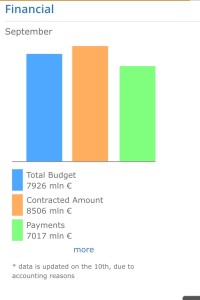
More than €7 billion is allocated to the European Structural Funds programme for Bulgaria for 2014–2020, exceeding €1,000 per Bulgarian citizen.
For Bulgaria's Structural Funds operational programmes for 2014–2020, more than €7 billion has been allocated in total. The scope and funding of the Operational Programme “Regions in Growth” 2014–2020 amount to €1,376,788,235, with 15% co-financing from the State. The programme has eight priority axes: sustainable and integrated urban development, State educational infrastructure, regional health infrastructure, regional social infrastructure, regional tourism, regional road infrastructure, risk prevention and technical assistance.
Investments under the “Regions in Development” Operational Programme will be implemented throughout Bulgaria and contribute to the socioeconomic and territorial development of Bulgaria’s less-developed regions, to align and reduce economic differences among the country’s development areas.
Invest Bulgaria Agency
Our Firm provides comprehensive assistance, including with the support and cooperation of leading companies in the sector, for all start-up projects, from submission of applications through to disbursement of funding. The business can subsequently receive legal advice tailored to every corporate need, from incorporation and contractual assistance for all forms of legal relationship necessary to carry on its business, through to any liquidation, merger or conversion.
- Guidelines – operational manual on Structural Funds for Bulgaria
- EUROPEAN STRUCTURAL FUNDS: BULGARIA 2014–2020 PROGRAMME
Economic planning document 2020