


















Why invest in Bulgaria?
Why open a company in Bulgaria?
Many entrepreneurs interested in investing and internationalising in the Balkans ask themselves this question.
There certainly cannot be a single answer! Opening a company abroad is not a decision to be taken lightly. Even though bargain prices for setting up a limited liability company in Bulgaria are advertised online, it is very likely that, once the Bulgarian company has been established, the entrepreneur will not have laid the foundations for an effective and efficient international expansion project.
A company is always incorporated at the end of a concrete business planning process, as one possible means of implementing the operational investment programme in Bulgaria.
A company in Bulgaria set up by ‘expert’ fixers, without a real and feasible idea based on knowledge of the market, the business and EU, national and international law, will be of no help to a serious, properly prepared entrepreneur.
Setting up a company in Bulgaria must therefore be planned carefully and cannot be left to advice from unprofessional and unqualified operators who claim that anything is possible and conduct their work in opaque and difficult-to-manage ways.
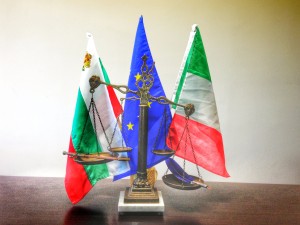
These brief considerations make it clear that professional advice from lawyers registered with and recognised by the professional bodies in the countries concerned, Italy and Bulgaria, provides the opportunity to develop an internationalisation project by planning a business abroad in an informed and professional manner.
Having experts in company law and Bulgarian and Italian contract law, as well as business advisers, at one's side is essential even when operating “at home”; doing business abroad without selecting a professional adviser is hardly conceivable. It should also be recalled that all Italian-owned consultancy companies operating in Bulgaria rely on local professionals without necessarily having the expertise to convey the client's actual requirements. There is a risk that the Bulgarian professional will not receive the foreign investor's true requirements because they have been filtered through unqualified intermediaries.
Entrusting your interests to opaque intermediaries is risky and unproductive, and is certainly one of the reasons why investing and operating abroad may not be worthwhile.
Bulgaria is an excellent strategic choice, provided that the investment begins with careful planning.
The main strengths of Bulgaria are summarised below:
-
Economic stability: a NATO member since 2004 and a member of the European Community since 2007;
-
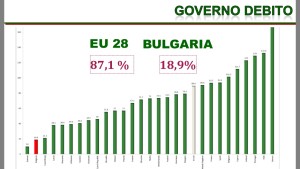
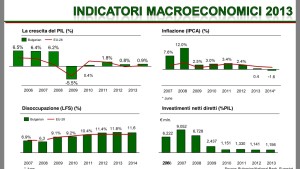
low public debt (around 19% of GDP, among the lowest in Europe)
-
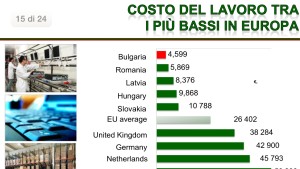
Low labour costs, the lowest in Europe;
-
low logistics and start-up costs (the lowest in Europe);
-
low electricity costs (among the lowest in Europe);
-
absence of significant restrictions on economic freedom (the international Doing Business report and the Heritage Foundation rank Bulgaria 58th);
-
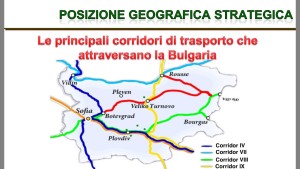
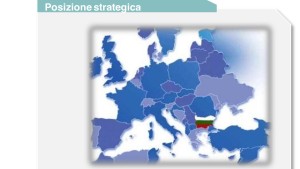
a strategic crossroads in the Balkans, crossed by the five pan-European corridors;
-
easy access to an Eastern European market of 122 million inhabitants, with access to the Russian, North African, Turkish and Middle Eastern markets of 500 million inhabitants;
-
quick, low-cost formation of LLCs (OOD) or PLCs (AD, with registered or bearer shares, the only case in “white list” Europe);
-
ratification of the main OECD international treaties on double taxation;
-
The possibility of keeping a company dormant even when it owns assets;
-
Availability of simplified accounting without VAT registration up to €25,000 per year;
-
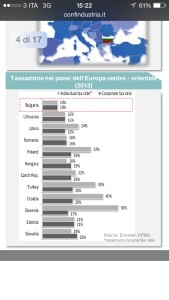
Highly advantageous taxation, with a 10% flat tax for companies and individuals (the lowest in Europe), 5% on profit distributions and VAT at 20%, with an efficient refund system for exporting businesses and free movement of capital;
-
steady economic growth, even during the current period of economic stagnation, with growth prospects above the European average;
-
fixed exchange rate with the euro under a currency board: EUR 1 = 1.995 LEV;
-
stability of the banking system;
-
a judicial system meeting European standards (average time to resolve a dispute: 568 days — Sofia Court);
-
continually expanding infrastructure supported by European funding, including motorways, railways, ports and the metro;
-
fast and efficient internet access;
-
Access to European Structural Funds for 2014–2020: over €14 billion through to 2020;
-
Italy is Bulgaria's third-largest trading partner;
-
a trained workforce and access to educated staff thanks to the presence of numerous universities throughout Bulgaria;
-
State incentives with tax-free areas in developing regions with high unemployment;
-
a territory conducive to food and wine development and manufacturing, in keeping with Italian SMEs; natural beauty, from mountains to the sea; culture, history and a continental climate;
-
an attractive location for European investors: first among Eastern European countries and 28th worldwide.
sole trader in Bulgaria, VAT registration in Bulgaria, opening a company in Bulgaria and working in Italy, Bulgarian VAT number, VAT registration in Bulgaria and working in Italy, Italian-Bulgarian chamber of commerce, taxation in Bulgaria, opening a company in Bulgaria, sole trader in Bulgaria, starting a business in Bulgaria, Bulgarian VAT number, Italian-Bulgarian chamber of commerce, what business to open in Bulgaria, taxation in Bulgaria, residence in Bulgaria, taxes in Bulgaria 2015, setting up a company in Bulgaria, Bulgarian VAT rate, Italy-Bulgaria tax treaty, VAT in Bulgaria, residence in Bulgaria, Bulgarian VAT number,