
How to read this article today
Aggregate data, sectoral changes and European comparisons must be read in the stated statistical period, distinguishing preliminary results from subsequent revisions. The concluding favourable view of investment is an opinion expressed at the time, not a current assessment of an individual project.
The text of the original article
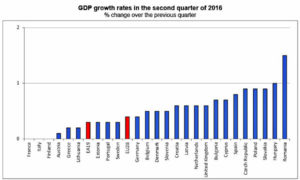
Bulgaria's dynamic GDP growth is confirmed. In the second quarter of 2016, gross domestic product (GDP) grew by 3.0% compared with the corresponding quarter of the previous year and by 0.7% compared with the first quarter of 2016, according to the Bulgarian National Statistical Institute. In the second quarter of 2016, Bulgaria's GDP amounted to BGN 21,916 million, or EUR 11,205 million, equivalent to €1,568 per capita. According to preliminary data, GDP in the second quarter of 2016 amounted to BGN 21,916 million at current prices. The per capita value of the indicator was BGN 3,067. Gross value added generated by the branches of the national economy in the second quarter of 2016 amounted to BGN 18,853 million at current prices. In the second quarter of 2016, agriculture's share of the economy's value added fell by 0.4 percentage points compared with the same quarter of the previous year, to 4.2%. Industry maintained its 29.3% share of the economy's value added. The share of value added generated by service activities increased to 66.5%, from 66.1% in the corresponding period of the previous year. Final consumption in the second quarter of 2016 amounted to 75.1% of GDP. Investment (gross fixed capital formation) accounted for 21.6% of GDP. The balance of trade in goods and services was positive. In the second quarter of 2016, GDP1 grew by 0.7% compared with the first quarter, according to seasonally adjusted data. Gross value added in the economy increased by 0.5%. According to preliminary data for the second quarter of 2016, final consumption increased by 0.2% compared with the previous quarter, while gross fixed capital formation increased by 0.5%. Exports of goods and services fell by 0.9% compared with the previous quarter, while imports of goods and services increased by 1.6%. Overall GDP grew by 3.0% in the second quarter of 2016 compared with the same quarter of the previous year, according to seasonally adjusted data. The trend in gross value added was driven by growth in: culture, sport and entertainment; other activities, 6.8%; financial and insurance activities, 5.6%; professional, scientific and technical activities; administrative and support services, 5.1%; repair of motor vehicles and motorcycles; transport and storage; hotels and restaurants, 4.3%; industry, 2.9%; production and distribution of information and creative products and telecommunications, 2.7%; real estate, 1.5%; government; education; human health and social work, 0.5%. As regards the components of GDP, final consumption contributed positively to economic growth, increasing by 1.8%. Exports of goods and services increased by 2.4% and imports of goods and services by 3.4%. Is Eastern Europe about to become Europe's economic engine? It is too early to conclude that Eastern Europe's economic recovery can continue and also pull other countries along, but it is certainly worth investing!
As confirmed by Eurostat, GDP growth compared with the first quarter concerned Eastern European countries, with the exceptions of Spain and Cyprus.
The full document follows:
http://ec.europa.eu/eurostat/documents/2995521/7607796/2-06092016-AP-EN.pdf/b7d23047-b2ed-43dd-873b-5d2f3dd1739c