The text of the original article
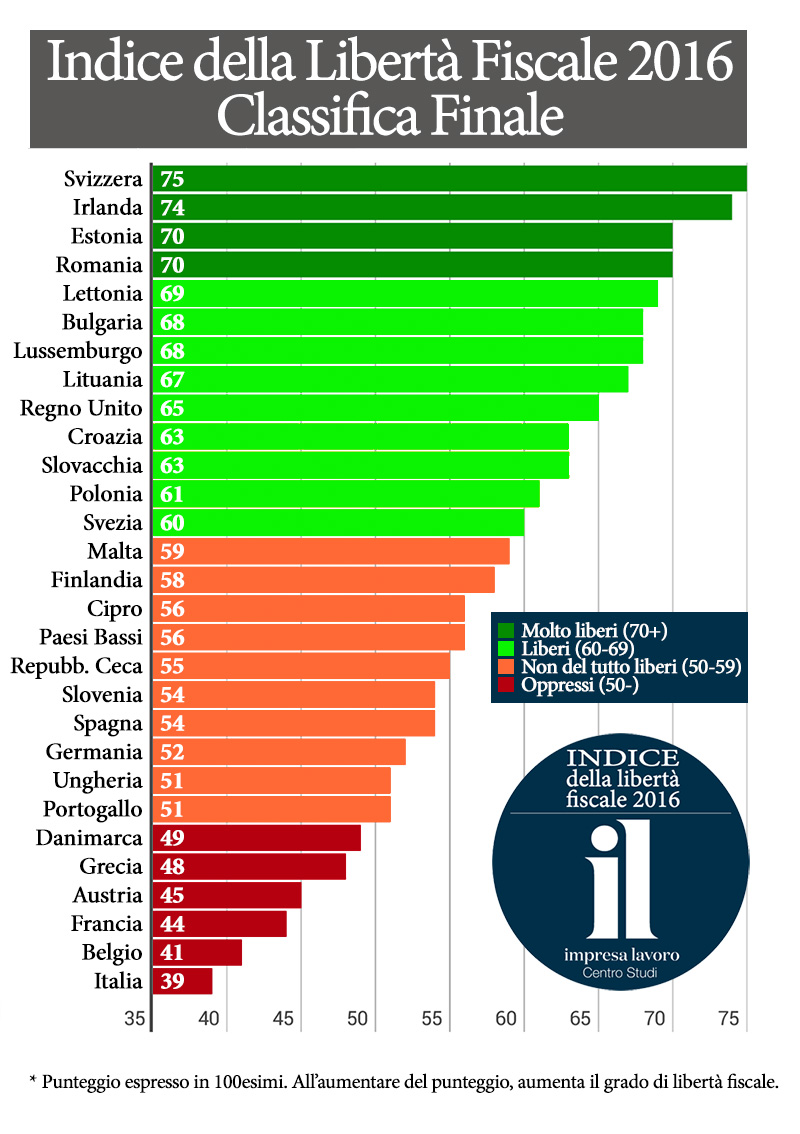
For the second year, the Impresa Lavoro research centre has produced a detailed study of taxation in European countries, expanding the number of countries examined compared with 2015.
The conclusion is certainly bitter for Italian businesses, which bear the highest tax burden of all countries!
Bulgaria ranks sixth, also because of the bureaucracy involved in paying taxes.
Some methodological notes need to be examined.
Methodology The Fiscal Freedom Index was developed using seven different indicators, each examining and monitoring a specific aspect of taxation. The country performing best on an indicator receives the maximum score for that category. Other economies receive scores through inverse proportionality: the further a country falls behind the best performer, the fewer points it receives. This approach favours good practice—or rather, the best practice—found in Europe. Setting hypothetical reference values and measuring deviations from a theoretical “perfect tax system” risked constantly comparing reality with a world that does not exist. Instead, the index starts from levels of fiscal freedom already achieved and uses them as benchmarks: if seven European economies can keep business taxation below 30% of profits, it is reasonable to believe that other countries can too.
The sum of the individual indicators gives each economy examined a fiscal freedom score on a scale of 100. The higher a country’s score (the closer to 100), the greater its citizens’ fiscal freedom. The resulting ranking divides countries into four broad groups: fiscally very free countries (over 70 points out of 100), fiscally free countries (60 to 69 points), countries not entirely fiscally free (50 to 59 points), and fiscally oppressed countries (below 50 points).
The figures compiled by Impresa Lavoro are based largely on the already published Doing Business data.
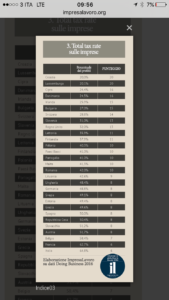
The total tax burden considered by the study for Bulgaria is 27%, the same as Luxembourg's.
In any event, the 10% flat tax adopted in Bulgaria remains the lowest direct tax rate within the European Union.