

In recent years, Bulgaria has attracted the attention of investors from Europe and beyond.
According to indications from the major international organisations, Bulgaria currently represents the best strategic choice for investing in the Balkans.
The latest World Economic Forum publications for 2016 place it 38th worldwide.
Drawing on experience from the previous economic programming period, a high absorption rate of around 90–95% of Bulgaria's European allocations was forecast for the 2014–2020 European Funds, some already operational, confirming the economic system's potential and efficiency.
Bulgaria has a highly diversified economy. Its traditional sectors include services, accounting for over 60%, followed by industry, representing around 20% of GDP, and agriculture.
The tertiary sector is undoubtedly the economic sector that has experienced the greatest growth in Bulgaria in recent years.
Tourism-related sectors are equally attractive, thanks to the range Bulgaria offers: winter tourism in its various ski resorts, summer tourism at Black Sea coastal resorts, and spa and food-and-wine tourism, both popular with visitors. Numerous hunting reserves are available for enthusiasts.
The real estate sector is also growing steadily. Since the end of the property bubble in 2009, sales have been increasing consistently and property prices have begun to rise again. Many European and non-EU investors have made and planned significant investments in real estate. It is also worth recalling that the foreign investment law gives foreign investors enhanced protection against expropriation of land for public purposes. The first additional protection mechanism for foreign investors rests on expropriation being permitted only exceptionally, to meet essential state needs that cannot otherwise be satisfied. Real estate owned by foreign persons cannot be expropriated for municipal needs.
For these reasons and other economic and financial considerations, the country has shown a strong ability to attract foreign investment.
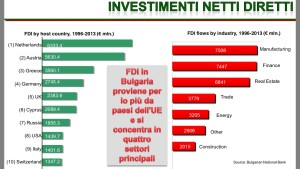
Italy is a strong trading partner for Bulgaria thanks to substantial economic exchanges that place Italy fourth in foreign investment in Bulgaria.
Italian businesses operate both indirectly through purchases and sales and, increasingly, by forming companies under Bulgarian law.
The supply of products, equipment, technology and services, and the execution of works financed by European funds, including infrastructure such as railways and motorways, are among the most common economic transactions.
Bulgaria is a signatory to the system of bilateral treaties for the promotion and reciprocal protection of foreign investment. In addition to national treatment, this system provides most-favoured-nation treatment for investments made by entities and individuals of one contracting country in the territory of the other. In particular, the principle of the priority of international treaties applies: where international treaties signed by Bulgaria provide more favourable terms and conditions for foreign investment, those rules take priority over local rules. This guiding principle is expressed in foreign investment protection treaties and, in particular, in agreements for the avoidance of double taxation. International treaties on reciprocal protection of foreign investment always rely on a broader concept of foreign direct investment (FDI), and application of that concept must take priority over Bulgarian legislation.
Under current Bulgarian legislation, a foreign investor, particularly an Italian investor, may: — establish a joint venture with a local Bulgarian operator by finding a local partner; — establish an Italian branch in Bulgaria to strengthen its market presence; — establish a new company under Bulgarian law; — acquire an existing Bulgarian business, including by participating in the privatisation process.
Bulgaria has adopted specific investment-sector regulations to create a particularly favourable climate for foreign investment, consistent with its opening to the market only after the fall of the Soviet regime.
In 2004, to accelerate accession to the European Union and narrow the considerable economic gap with other EU countries, Bulgaria introduced a new law on incentives for foreign investment to create an attractive environment for foreign investors.
The Bulgarian Constitution recognises foreign investors as having equal standing with Bulgarian entrepreneurs and guarantees their rights in accordance with the law.
In particular, Bulgarian law imposes no restrictions on foreign equity participation or specific authorisation requirements, except for investments in sectors considered sensitive: production and export of arms, ammunition and military equipment; banking and financial services; exploration, exploitation and development of natural resources; and acquisition of property in particular areas or zones of the country. Only in these sectors is authorisation issued by the Council of Ministers, except in banking, where the competent institution is the Bulgarian National Bank (BNB).
Activities carried out by foreigners in Bulgaria are subject to registration with the local tax office, the local social security office where foreign investors are also employers, and the national statistical institute.
Bulgarian law also provides protection for investments against expropriation or nationalisation, except for reasons of national interest and subject to adequate compensation, and allows profits and capital to be freely transferred out of the country.
The investment legislation also provides specific incentives. To qualify for foreign investment incentives, the investment must concern the acquisition of specific business assets for the purpose of creating, expanding or modernising existing production of goods and/or services; new jobs must be created; and the project must be completed within three years.
In areas with high unemployment, programmes and measures are also provided for the employment in Bulgaria of young people and members of disadvantaged social groups. In such cases, the Employment Agency may cover wages and other charges for the duration of each person's employment contract (but for no more than 12 months). Tax incentives are also provided for investments in high-unemployment regions included in the list approved by the Ministry of Finance.
Each incentive is subject to certain requirements and notifications both before and after implementation. When the value of exemptions and State aid for regional development exceeds BGN 75 million (approximately EUR 37.5 million), authorisation from the Commission for Protection of Competition is required.
Where State aid and subsidies, excluding tax concessions, do not exceed BGN 200,000, approximately €100,000, over three years, tax concessions may be used under more favourable conditions.
Manufacturing companies that decide to invest in regions with high unemployment (generally above 35%) are entitled to full exemption from business income tax (10%) if they meet the following conditions: all production facilities, offices and other sites attributable to the taxable entity must be located in the relevant region; all assets of the taxable entity must be located in that region, except cash held in bank accounts and investments in associated companies or subsidiaries; the taxpayer must have no tax or social contribution arrears or debts relating to the year for which the exemption is requested.
The tax credit, equal to 10% of profits each year (given Bulgaria’s flat tax), must be invested in manufacturing activities within three years of the end of the year for which the exemption is claimed.
All reliefs may be used for a maximum of 5 consecutive years, provided that the conditions are met in each individual year.
A preferential VAT regime is also provided for imports of goods necessary to implement an investment project. Investors with a Bulgarian VAT registration are entitled to import goods to be used in such projects without paying import VAT on them. These investors are also entitled to a refund of VAT paid on local purchases within 10 days of filing the refund application, provided that at least 80% of monthly VAT amounts are paid through a dedicated VAT account.
To benefit from this special regime, the investor must obtain prior authorisation from the Ministry of Finance based on the following conditions:
• The investment must be at least BGN 10 million (€5 million) over a period of no more than two years; • the project completion period must not exceed two years; • the project must create at least 50 jobs; • the project must be eligible for State aid for regional development; • the investor must demonstrate the ability to finance the project.
A further safeguard for foreign investors is that the law requires compensation in the form of another property in the same area, or in another area with the foreign investor's consent, or in cash if the investor chooses that option. Compensation equals the property's market value on the date of expropriation.
The international treaty between Italy and Bulgaria for the avoidance of double taxation has been in operation since 10 June 1991. It is based on earlier models developed and recognised by the OECD, with the aim of avoiding double taxation of income and capital.
The provisions of the treaty in force take precedence over domestic rules, including tax rules.
Bulgarian company law is governed by the Commerce Act, which entered into force on 1 July 1991. The main company forms regulated by the Act are joint-stock companies, limited liability companies, limited partnerships and general partnerships.
Joint-stock companies and limited liability companies have legal personality. Moreover, regardless of their shareholders' nationality, any company incorporated under Bulgarian national law is regarded as a Bulgarian company, or a company governed by Bulgarian law. The law lays down common rules, irrespective of company type, for drawing up the constitutive instrument, also called the company agreement. It must contain essential details such as the proposed company's name and registered office, its purpose, shareholder and member details, the amount of contributions in kind and cash for limited and general partnerships, and share capital for joint-stock and limited liability companies. Under Bulgarian law, a company is regarded as legally incorporated only after registration in the Commercial Register of the competent local district where its registered office is located. Changes within the company that must legally be registered must be notified to the Commercial Register within seven days of occurring.
The Commercial Register is currently maintained by the Registry Agency, which replaced the register maintained by the district courts with territorial jurisdiction over a company's registered office. The new Commercial Register, in force since 2008, operates nationally. The official website provides free access to information about duly registered companies governed by Bulgarian law. The Commercial Register can be accessed at www.brra.bg and is also available in English.
Thanks to reforms of commercial law, the most widely used company form in Bulgaria is the limited liability company. Shareholders in a Bulgarian limited liability company are liable only up to the capital contributions paid by each of them, and the company has fully separate assets with which it answers for its corporate obligations. The minimum share capital is equivalent to approximately €1 and there are no limits on capital contributions. Companies may also be established by a sole shareholder; at least 70% of the capital must be subscribed upon incorporation and paid before the company is registered in the Commercial Register. Transfers of shares between shareholders are not subject to restrictions. Companies incorporated under Bulgarian law may operate within and outside the European Union. Bulgarian limited liability companies are subject to corporate income tax. Income is taxed at company level, while distributed profits are also taxed when paid to shareholders. The standard corporate income tax rate is 10% (flat tax). The Bulgarian tax authorities do not distinguish between resident and non-resident companies: for tax purposes, a non-resident company is treated as resident if it has been registered under Bulgarian national law. No advance payments are required for taxation relating to years following the previous year. The Bulgarian tax system is neutral towards shell companies and there is no minimum taxation based on sector studies. Companies tax-resident in the country are liable to tax on their entire income, regardless of where it was earned, in accordance with generally recognised international principles. Bulgaria has concluded international double taxation treaties with the world's major economies. As regards indirect taxes, the rules governing value added tax have characteristics similar to those of other European countries. The standard VAT rate is 20% of the transaction value, including all expenses, taxes, subsidies and interest forming the taxable amount. A 9% rate applies only to hotel tourism services. All persons, both individuals and legal entities, whose taxable turnover in the previous year exceeded BGN 50,000 (approximately €25,000) must register for VAT, as must non-residents conducting an independent economic activity in Bulgaria that meets all statutory requirements. Branches of foreign companies must also register for VAT in the country. They may, however, register directly, without appointing a tax representative.
VAT returns are filed monthly, and the system for refunding intra-Community VAT is efficient. Companies must be registered for VAT to issue VAT-exempt invoices for intra-Community supplies.
Investing in companies in Bulgaria — opening, incorporation, management, administration, information about Bulgarian companies, their advantages and taxation, Bulgarian VAT registration
Investing in property in Bulgaria, buying a home in Bulgaria, purchasing Investing in property in Bulgaria, buying a home in Bulgaria, purchasing property in Bulgaria, a home in Bulgaria, property investments in Bulgaria, Investing in companies in Bulgaria — opening, incorporating, managing, administering, information about companies, the advantages and taxation of Bulgarian companies, Bulgarian VAT number, investing in Bulgaria, Bulgarian company, Bulgarian law, Bulgarian limited liability company, limited liability company in Bulgaria, taxation in Bulgaria, investing in Bulgaria, EU funds in Bulgaria, property in Bulgaria, investing in the property market, Bulgaria, incorporating a company in Bulgaria, managing a Bulgarian company in Bulgaria, a home in Bulgaria, property investments in Bulgaria, Investing in companies in Bulgaria — opening, incorporating, managing, administering, information about companies, the advantages and taxation of Bulgarian companies, Bulgarian VAT number, investing in Bulgaria, Bulgarian company, Bulgarian law, Bulgarian limited liability company, limited liability company in Bulgaria, taxation in Bulgaria, investing in Bulgaria, EU funds in Bulgaria, property in Bulgaria, investing in the property market, Bulgaria, incorporating a company in Bulgaria, managing a Bulgarian company